From Sprawl to Structure: The Internet Needs Planners
Written for Living in an Urban Planet (GENED 1103), a course at Harvard College taught by Professor Bruno Carvalho.
Abstract
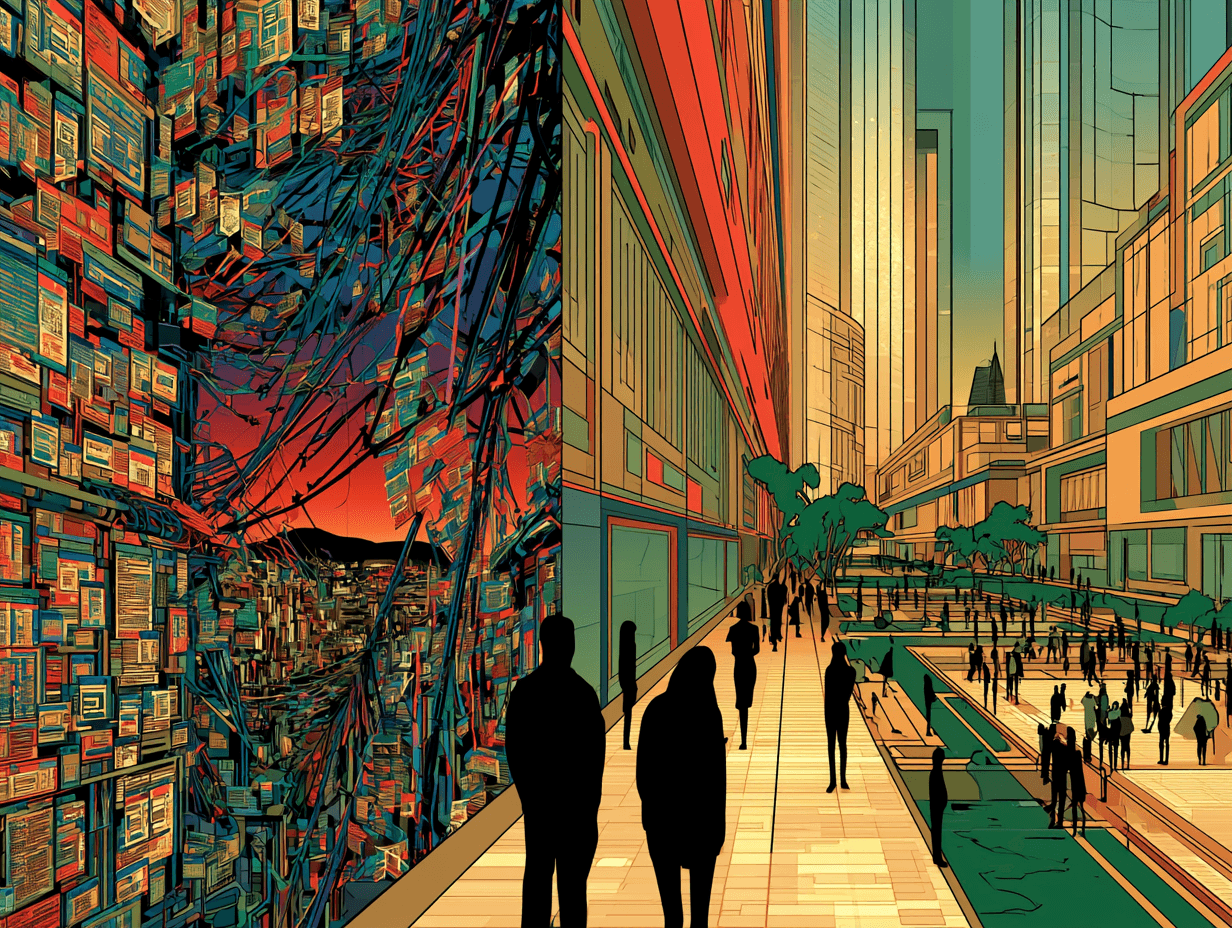
This paper proposes a reimagining of the digital environment by applying principles derived from millennia of urban living and design. Today's online experience is largely a fragmented and ad-driven field of discrete applications, websites, and platforms, offering little in the way of intentional structure or meaningful spatial metaphor. By contrast, the world's great cities have evolved thoughtful arrangements of public squares, residential neighborhoods, thoroughfares, and cultural institutions, each crafted to encourage social interaction, cultural enrichment, and personal well-being. This paper suggests that we can leverage these urban concepts — zoning, walkability, mixed-use districts, public-trust institutions, and curated cultural spaces — to guide the evolution of digital tools and interfaces. The goal is neither utopia nor top-down control, but a more humane, user-led virtual environment that balances navigation and discovery with comfort and trust. In doing so, we may grant digital life the coherence and dignity it often lacks today, enabling individuals and communities to build environments that reflect their values and aspirations. The intervention proposed is the creation of a software company to serve the role of urban planners and designers in the digital realm.
Introduction
The internet, as it exists today, can be reasonably understood as a series of overlapping and often haphazardly assembled systems, each tugging at human attention and striving for incremental engagement. When we open a conventional web browser or unlock a smartphone, we step into a world devoid of subtlety and spatial logic: a flat matrix of bookmarks, infinite feeds, disparate applications, and algorithmically guided content funnels. This arrangement, birthed in the early desktop era, has scarcely evolved beyond its basic function as a digital index of services. Its primary mission remains one of utility and access, rather than fostering cohesive, meaningful user experiences.
Such a system may suffice for the strictly task-oriented, but it struggles to meet the more nuanced human desires that shape healthy daily life. We are a species that builds villages, roadside motels, pedestrian crossways, informative signage, artistic endeavors, and cultural institutions not merely to survive, but to live well. These physical environments, iterated and refined over millennia, serve as more than backdrops: they are frameworks that guide human interactions, patterns of movement, cultural exchanges, and the formation of trust and identity. By carefully attending to form, function, and flow, urban planners have helped to foster societies that find balance between commerce and leisure, solitude and community, tradition and innovation.
Our digital ecosystems have not followed the same path. Instead of libraries, we have search queries; instead of public plazas, we have social feeds run by profit-driven algorithms; instead of neighborhoods that grow organically through shared stewardship, we have app silos that neither speak nor listen. Crucially, we have little choice but to navigate these fractured landscapes through interfaces and metaphors that no longer reflect the complexity of digital life. The result is a persistent sense of disorientation and dilution; our digital "homes" feel hollow, our digital "streets" disordered.
This paper proceeds from a simple premise: that we might restore coherence and intention to our digital lives by drawing on the wisdom embedded in real-world urban forms. It is a philosophical and practical reflection, proposing new metaphors and architectures that place human curation and community-building at the center of digital design. We will first consider the digital environment as if it were a city, using familiar urban metaphors to highlight its current deficiencies. Then, we will identify key urban-planning principles and examine how these might be translated into code, interfaces, and governance models online.
Finally, I offer a vision and a blueprint for a new class of digital tools: environments where users construct their own digital neighborhoods in internet space. By nurturing communities of trust, enabling curated exploration, and encouraging purposeful place-making, we can move beyond a web designed for clicks and toward one designed for living and learning. I do not claim to solve the internet's every ill, but to suggest a different approach — one that, if carried out with humility and patience, may help us build a digital world as vibrant and resilient as the cities and towns we have cherished for ages.
Philosophical Foundations: Digital vs. Physical Spaces
As a species, we have long relied on spatial organization to navigate the world, to form meaning, and to seek knowledge. Physical space does not merely offer a backdrop to human action; rather, it actively shapes our interactions, values, and traditions. Throughout history, communities have invested immense effort in orchestrating their environments: aligning roads for trade, situating public squares to foster discourse, and designing homes to support rest and family life. The result is a tapestry of human experience woven into the geometry of streets, plazas, and structures.
In this context, space itself can be understood as an instrument for information access. As we move through physical environments, we traverse layers of meaning. A street sign provides guidance and local history, a neighbor's smile signals trust and familiarity, and a dentist's office signals a place of specialized knowledge and care. In essence, our perception of space, and the ability to navigate it, is a fundamental vector by which we approach, interpret, and utilize information.
By contrast, digital environments emerged in an era of technical novelty and business opportunity, developing largely under the pressures of scale, market competition, and immediate engineering requirements. Little attention was paid to the logic of experience-oriented infrastructure or the community value that enriches our everyday physical experiences. Early designers did not set out to recreate the comfort of a home, the vitality of a marketplace, or the shared meaning of a public square. Instead, they sought efficiency: efficient routing of data packets, efficient indexing of documents, efficient ways to capture user attention for profit.
This focus on efficiency and commercial interest offered unimaginable convenience: instantaneous search results, seamless online transactions. But it did so at the cost of coherence and intentionality. The internet rapidly became a boundless sprawl of content without thoughtful zoning, plazas, or trust-building institutions. In physical life, the home is a sanctuary that imposes a comforting spatial logic on personal belongings and daily rituals. Online, we contend with cluttered desktops, scattered apps, and feeds that stretch infinitely, each piece of information disconnected from any greater narrative. We lose the anchoring that well-designed physical spaces offer.
When considered this way, the internet's current architecture appears impoverished. It is capable of infinite expansion, yet lacks the contextual cues and thoughtful design that make physical spaces so meaningful. Without a guiding philosophy that prioritizes human values, digital environments risk becoming a shapeless expanse of disassociated data and fleeting interactions. Understanding that the internet, too, is a lived environment — one that can be shaped, curated, and improved — challenges us to design digital spaces as carefully as we design the physical ones that have nurtured civilization for millennia.
The Current Problem: What If Digital Spaces Were Physical?
To better grasp the shortcomings of today's digital landscape, consider the everyday experience of using a conventional web browser, the interface so familiar we seldom question it. In a single window, dozens of tabs sprout like an overgrown garden, each representing a different piece of your online life: your bank's webpage sitting next to a cooking tutorial, an endless feed of social media updates beside a cloud-based spreadsheet, your guilty-pleasure streaming platform mere pixels away from your professional email. Bookmarks accumulate over the years, forming a neglected index of half-remembered destinations, while search results cascade endlessly, each competing for your attention. Authentication screens ask for passwords and two-factor codes, layering friction and fragmentation into what should be a coherent journey.
If we translate this digital jumble into a physical analogy, it begins to resemble an overstuffed warehouse — or worse, a city without any planning, zoning, signage, or spatial logic. Imagine being in three places at once: your college classroom, the football stadium, and your own bedroom talking privately with your spouse, all at the same time. Your daily errands, guilty pleasures, professional obligations, and interpersonal communications jostle against each other, vying for attention and space without respect for personal boundaries or context. The human species' attention faculties inevitably diminish.
In a well-designed city, distance and deliberate arrangement provide meaningful structure. A short walk might separate your favorite café from your workplace, allowing you to shift mental gears as you move. A library stands apart from a theater, a bank from a pub. These distinctions are not merely aesthetic. They are essential navigational cues that help you orient yourself, manage your focus, and maintain a sense of mental and emotional equilibrium. But in the current digital environment, everything shares the same flat plane of a single browser interface. Without thoughtfully placed boundaries or distinct neighborhoods, it becomes all too easy for work stress to spill into leisure time, for financial tasks to intrude on relaxation, or for entertainment to erode the separation you need for concentration.
The result is not just inconvenience; it is a subtle undermining of user autonomy and well-being. With so many tabs clamoring for your gaze and bookmarks stagnating in endless lists, it becomes harder to cultivate an intentional online life. The absence of clearly defined "locations" and the lack of conceptual "transportation networks" to guide you between them means that the digital world offers immense possibility but little peace. In short, we've built our primary gateway to the internet like a sprawling, unplanned metropolis contained within a single, crowded room — no boundaries, no zoning, no coherent paths.
The logical next step is to envision an alternative: a digital environment where tools, services, and experiences are situated in distinct, accessible "places." Rather than opening countless tabs in one place, you might travel through a series of carefully curated and customized districts: a "financial district" for banking and bill payments, a "marketplace" for ordering food, a "cinema district" for streaming entertainment. You could maintain clear lines between work and leisure, ensuring that you move through a digital world that reflects the rhythms and requirements of your own life. In such a setting, location and boundary become as meaningful online as they are in a well-planned city, guiding you not only to what you seek but also through a more organized, intentional digital existence.
Lessons from Urban Planning and Design
For millennia, human societies have grappled with how to structure physical environments in ways that support safety, commerce, culture, and well-being. Across eras and continents, a canon of principles has emerged that collectively ensures that cities function as more than haphazard accumulations of structures. Instead, they become living systems where society and humanity can flourish.
One of the core mechanisms of coherent modern urban design is zoning: the act of dividing space into designated areas for residential, commercial, and communal activities. By separating a bustling marketplace from a quiet residential lane, planners reduce noise, conflict, and confusion, providing citizens a mental map that allows them to move fluidly between different modes of life. Another principle, connectivity and flow, emphasizes the importance of designing pathways and nodes that encourage meaningful encounters. Markets open onto squares that host music, debate, and laughter; wide, walkable boulevards connect neighborhoods to parks and museums, inviting citizens to traverse their city with ease and curiosity.
Cities also rely on civic institutions and cultural spaces — libraries, museums, theaters, and parks — that serve as repositories of collective memory, creativity, and trust. These places, supported by public interest rather than private profit, transcend mere utility. They function as sanctuaries of learning and community, fostering attachments and identities that tie individuals more deeply to their collective environments. Further, access to these spaces is not decided by private algorithms; rather, the structures themselves are fixed in the spatial dimension, enabling the passerby to interact with them. Human-centric design prioritizes the pedestrian, ensuring that streets feel safe, inviting, and scaled to human presence rather than to machines or profit motives alone. Taken together, these elements shape environments that not only sustain life but enrich it.
The impacts on society have been profound. Thoughtfully planned cities support mental health by offering quiet retreats amid urban bustle. They encourage cultural exchange through well-placed squares and festivals, forging bonds that cross lines of class, language, and origin. Over centuries, we have learned to appreciate these qualities: harmonious neighborhoods, navigable districts, accessible cultural infrastructure. Such design choices do more than beautify a landscape; they cultivate trust, civic pride, and a sense of belonging. We know that good environments create good neighbors, that elegant public spaces nurture empathy, and that accessible pathways generate both literal and metaphorical bridges between individuals and ideas.
Though drawn from the brick-and-mortar world, these lessons can guide us as we seek to intentionally rebuild our digital environments. After all, the goals remain startlingly similar: to form communities rather than crowds, to foster understanding instead of confusion, and to ensure that traversing one's environment — whether physical or virtual — yields interactions that are meaningful, reliable, and humane.
Applying Urban Planning Principles to Digital Architecture
Translating these urban principles into the digital realm requires more than superficial analogy. It demands a recognition that the digital environment, too, is a space people inhabit. We can begin by experimenting with digital zoning: carving out spaces for personal reflection, social engagement, professional tasks, and cultural immersion. Instead of each user's screen presenting a jumbled array of equal-priority icons, we can introduce a spatial grammar that sorts content into "districts": a corner for intimate conversations with family, a separate node for professional documents and tools, and a community commons for open dialogue and cultural exchange. Residents can zone their own digital worlds, building virtual spaces aligned with their priorities and intentions.
Residents must have access to both "public squares" and "private rooms." Public squares, in digital form, might be platforms where curated content or community-vetted discussions flourish openly. They would be places one visits to encounter new ideas, debate current events, or appreciate a rotating gallery of media chosen by trusted curators. By contrast, "private rooms" would be personal spaces — cozy, familiar interfaces that contain one's most treasured applications, archived documents, or close-knit social groups. In this way, the digital world could borrow from the intuitive comfort and clarity that physical environments provide. Both are necessary, as is their separation.
Rather than surrendering to the logic of infinite scrolling, we might create guided pathways and curated journeys, much like a city's well-planned routes that connect a library to a museum, a café to a public garden. Imagine entering a specialized "knowledge corridor" where a curated sequence of content — articles, videos, games, AI chatbots — leads you from a basic introduction of a topic to deeper, more nuanced explorations. Such structured paths counteract the disorientation of endless feeds. They encourage users to roam thoughtfully, to linger where interest sparks, and to see how pieces of information fit into a coherent landscape. If you want to learn about urban planning, then take a trip to the popular urban-planning district, curated and built by a community of enthusiasts.
Finally, the digital equivalents of libraries, markets, and museums emerge as hubs of trust and intentionality. A digital library could be a collaboratively built repository of recommended readings, where quality is upheld by community librarians rather than ad-driven algorithms. A digital marketplace might take the form of a carefully arranged suite of productivity tools that users can rearrange and customize, like a well-stocked bazaar where each stall has been vetted for honesty and craftsmanship. And digital museums could highlight curated collections of art, music, and educational material, offering cultural nourishment without the frenzy of mass-market platforms.
By applying these principles, we push beyond the notion of the internet as a collection of unrelated apps and pages. Instead, we reframe it as a meaningful environment: a place with distinct districts, trusted institutions, and navigable routes that invite depth and understanding. In this imagined future, digital spaces would uphold the same human-centric values that have guided our best physical environments, thereby delivering not only utility and connection but also coherence, trust, and a richer sense of dwelling in our virtual domains.
Scope of the Proposed Intervention: A Platform for Human-Curated, Urbanized Digital Spaces
Reimagining our digital world as a coherent, human-scaled environment demands more than theoretical principles; it requires an infrastructural shift in how we access and interact with the internet. We must move beyond the notion of a single, static browser or a cluttered desktop interface. Instead, we propose building a platform for human-curated, urbanized digital spaces. This platform would enable individuals and communities to design their own digital infrastructure, shaping personal "rooms," "streets," and "neighborhoods" according to their values, interests, and professional goals.
This concept envisions a software company focused on empowering users to transcend the fragmentary nature of current digital systems. In place of a uniform browser window, imagine a dynamic canvas where each user curates their environment as they might organize a family home or community center. Customizable templates, modular design tools, and communal planning features give rise to a multiplicity of digital habitats: intimate spaces for shared hobbies, specialized rooms for personal projects, and public squares for open discourse.
This intervention is not confined to a single city or region, because the internet transcends physical geography. The platform would exist globally, accessible to anyone with a connection. However, its scale and character would be locally and individually determined. A user in Tokyo might craft a serene "study alleyway" linking language-learning tools and news sources; a family in Lagos could design a communal "living room" centered on music streaming and personal finance apps; a creative collective in São Paulo might develop a vibrant "arts corridor" showcasing multimedia portfolios and weekly live performances. By recognizing that "place" in a digital sense can be shaped by cultural context, personal preference, and group interest, the platform accommodates both global participation and localized distinctiveness.
The desired impact is twofold. First, at the individual level, we seek to reduce the overwhelming nature of contemporary digital life by introducing intentional boundaries, thematically coherent enclaves, and accessible navigation paths. Users should be able to find what they need — research materials, financial tools, entertainment, or social connections — without wading through a sea of irrelevant tabs and infinite scrolls.
Second, at the communal level, we aim to foster trusted, meaningful relationships in digital environments. By designing curated "neighborhoods" rather than relying solely on algorithmic feeds, communities can nurture shared values, define their own organizational principles, and build stable cultural infrastructures. We believe this approach can restore autonomy and trust in the digital landscape, allowing people to form deeper connections and strengthen social bonds that transcend traditional geographic boundaries.
Justifying this chosen scale is straightforward: the existing modes of digital interaction — globally networked yet spatially agnostic — encourage fragmentation and overwhelm. By applying principles of urban planning and place-making at the scale of the internet itself, we can guide users toward more intentional, human-centered digital environments. This global reach, coupled with local adaptability, creates a flexible framework capable of evolving as communities form, grow, and redefine their collective needs.
Key Features
- User-designed "neighborhoods." Just as physical neighborhoods emerge from shared histories and collective preferences, digital neighborhoods would arise from user initiative and collaboration. A family might create a warm, visually coherent living room filled with cherished media, communal tools, and communications that replicate the comfort of shared evenings at home. Artists could form a creative studio space, lined with portfolios, design tools, and message boards for constructive feedback.
- Shared templates and architectural patterns. Much as urban planners rely on proven blueprints for public squares or pedestrian-friendly lanes, users would have access to a library of templates informed by best practices. These templates, ranging from "study alcoves" to "local marketplaces," help newcomers quickly establish functional, visually appealing spaces. Over time, a culture of knowledge-sharing would form, with trusted "digital architects" distributing innovative patterns tailored to different community needs.
- Curatorial roles. A new class of user might emerge: digital curators, akin to librarians, city planners, or museum directors. These individuals would excel at bringing order, thematic cohesion, and authenticity to shared environments. Their role would be neither purely commercial nor authoritarian, but rather a form of community service, helping to shape spaces where quality, trust, and mutual enrichment prevail.
- Incentives for quality over quantity. By reconfiguring the underlying incentive structures, this platform need not rely on intrusive advertisements or aggressive data harvesting. Instead, users could endorse neighborhoods they find helpful, aesthetically pleasing, or conceptually rich. Over time, these reputational signals would guide new visitors toward domains distinguished by careful curation and genuine community contribution.
In this new paradigm, we strive for digital navigation to become a deliberate journey rather than a frantic scavenger hunt. As these spaces evolve and interconnect, a vast digital spatial realm emerges: one that supports learning, shared artistry, civic discourse, and the blending of personal reflection with social engagement.
Precedents
While the vision outlined here may appear unprecedented, it builds upon a lineage of attempts, however limited, to impose order and meaning on the online world. Search engines, for instance, have always functioned like teleportation devices: rather than starting from a familiar "home" environment and following a path to their destination, users input a keyword and instantly get a list of "relevant" results, curated by a profit-incentivized corporate algorithm, from which they quickly choose where to magically end up. This approach offers immense convenience, yet it bypasses any sense of planned spatial progression or intuitive exploration. Browsers, in turn, evolved from simple navigation tools into portals for every facet of digital life, but their structures — tabs, bookmarks, and flat hierarchies — were never truly scaled to handle the explosive growth and complexity of the internet. More recent efforts, such as the Arc browser, exemplify a new wave of specialized interfaces seeking greater efficiency and elegance, often by refining shortcuts and improving user-computer interactions. Yet these refinements address symptoms rather than root causes. They make it easier to control a chaotic landscape, but do not fundamentally reimagine the terrain itself.
The approach proposed here seeks to integrate the lessons of urban planning to inform not just how we interact with the interface layer, but how we conceive of the digital ecosystem as a place to be navigated with intention. Combining human insight, community curation, and thoughtful design metaphors, this vision moves beyond incremental improvements and asks us to rebuild the online world as a set of well-structured, meaningful environments.
Collaborative software suites such as Notion or Trello present another partial precedent. They empower users to organize information, tasks, and workflows in modular, flexible layouts. Yet their focus remains chiefly on productivity and efficiency, not on cultivating communities, cultural identity, or recreational intellectual life. These tools hint at the potential of user-centered customization while underscoring the absence of a broader vision — one that extends beyond sterile functional utility.
Perhaps the closest analogs lie in small-scale online communities that emerge naturally around niche interests: forums and fan communities where members self-organize, moderate norms, and curate knowledge. Such communities are like tiny neighborhoods that survive despite, rather than because of, the larger digital terrain. They demonstrate that people can and do form vibrant micro-societies online when given the freedom and the right tools, such as Reddit. The missing step is to provide a more robust infrastructure: a set of principles, interfaces, and incentives informed by urban theory, cultural institutions, and user-led curation. This is the leap our intervention aims to achieve, turning scattered precedents and half-realized concepts into a comprehensive framework for intentional digital place-making.
Challenges
Translating a theoretical proposal into functional reality requires acknowledging and addressing a series of significant challenges. The first set of hurdles is technical. Building a platform capable of supporting infinite customization — where individual "neighborhoods" vary dramatically in form and function — demands a flexible, modular architecture. This infrastructure must scale as user bases expand and content proliferates, while also integrating different third-party tools, data sources, and services. Achieving this combination of extensibility, stability, and adaptability goes beyond standard web applications, and will require meticulously designed protocols and abstraction standards.
Social and cultural challenges loom just as large. For users long accustomed to passive consumption and the convenience of prepackaged feeds, shifting toward a model of active curation will require thoughtful onboarding, education, and sustained encouragement. Instead of optimizing for "lowest-effort engagement," the platform must help newcomers see the value of investing time in building and residing in their own digital habitats. Moreover, as communities form and evolve, the delicate tasks of moderation and trust-building emerge. While the platform's architectural principles may reduce hostility and fragmentation, they cannot eliminate it entirely. Genuine, decentralized stewardship, fostered by curators and community guidelines, will be needed to ensure that digital neighborhoods remain welcoming and respectful.
Economic and market barriers will test this vision's viability. Entrenched platforms and profit models, addicted to attention extraction, have established norms and expectations that shape user behavior. Competing on quality and trust rather than raw engagement will demand patience and clever strategies. Without surveillance-based advertising as the default revenue stream, the platform must explore sustainable business models that uphold user interests. Subscription tiers, community-funded "civic" areas, or donations to trusted curators might emerge as alternatives. Yet persuading users, investors, and public stakeholders to support a model that privileges human-centered design over relentless growth will require careful alignment with broader cultural shifts toward digital well-being and ethical technology.
Informed Speculation: Potential Ramifications
If this initiative succeeds, the digital sphere could undergo a quiet but profound transformation. The most immediately noticeable change would be a more balanced online life: users experiencing less cognitive clutter and fewer conflicting demands for their attention. By engaging with thoughtfully zoned neighborhoods and curated galleries of knowledge, individuals could gain a sense of orientation and purpose online. Over time, this might strengthen communities, as people find it easier to gather around shared interests and partake in dialogues informed by trust and mutual respect.
Cultural enrichment stands out as a major potential benefit. The institutionalization in digital space of museums, libraries, and public squares would provide fertile ground for collective learning, the celebration of heritage, and cross-cultural exchange. Without the gravitational pull of algorithmically amplified content, users could discover new interests, access niche expert knowledge, and appreciate aesthetic sensibilities that would have remained buried under layers of commercial noise. This cultural flourishing might, in turn, reinforce healthier digital habits and more robust social fabrics.
Yet these positive outcomes are not guaranteed. There is a risk that the platform could inadvertently contribute to new digital divides: those with time, resources, or technical literacy may craft richly curated environments, while others default to simpler, less nourishing templates. Fragmentation is another concern. Without some means of bridging communities, these tailored neighborhoods may become insular, limiting the serendipitous encounters that foster empathy and innovation. Additionally, there is a possibility that over-curation — an overly rigid application of these principles — could sterilize the discovery process, reducing the variety and unpredictability that many users find appealing online.
The future this vision sketches represents a direction we might choose to explore, armed with lessons from centuries of urban design and a renewed focus on human agency. The challenge lies in balancing the virtues of structure and curation against the openness, dynamism, and creative chaos that are also essential to a healthy digital ecosystem. If approached with humility, adaptability, and ongoing dialogue, we might discover that bridging the physical and digital through principles of good urban planning leads us closer to an internet that is not merely functional, but genuinely livable.
Toward Implementation: Strategy and Next Steps
Translating these concepts into a functioning platform is both a technical and cultural undertaking that must proceed deliberately and thoughtfully. The initial focus should be on pilot communities: intimate groups of users who share a common interest, mission, or cultural background — for example, the community of early-stage young startup founders. These early adopters can help refine the platform's tools, test emerging architectural patterns, and provide candid feedback on user interfaces and spatial metaphors.
Once a sturdy foundation has been established within these pilot communities, the next phase involves broadening the platform's reach. This step might include building out libraries of preconfigured templates and modular design elements that lower the barrier to entry for new users. Standardized architecture guidelines and curated best practices could accelerate adoption, making it easy for others to adopt tried-and-true structures. Partnerships with cultural institutions — universities, governments, or professional sports leagues — may also prove crucial. Ultimately, as more communities join and more refined templates circulate, the platform's "urban fabric" should begin to feel genuinely alive: an interlinked landscape of neighborhoods, plazas, and institutions that together form a vibrant, human-centered digital world.
Conclusion
This paper has argued that the digital environments we inhabit today, though ever-growing in scale, remain impoverished in their design and imagination. By examining how physical spaces have been shaped over centuries to foster trust, cultural exchange, and human well-being, we find models for addressing the fragmented, ad-driven chaos that currently defines much of our online experience. Through the lens of urban planning, we can conceive of digital "zoning," curated "public squares," culturally rich "museums," and navigable "neighborhoods," each of which lends coherence, warmth, and purpose to the online world.
The vision outlined here is not a blueprint for a perfect digital realm, but a call to explore a more thoughtful path. It encourages designers, developers, policymakers, entrepreneurs, cultural institutions, and everyday users to step beyond the status quo. Instead of accepting infinite scrolls and attention extraction as inevitable facts of digital life, we can choose to engineer environments that promote depth, trust, and communal enrichment. By uniting urban-design principles with the fluidity and accessibility of the internet, we may at last humanize the digital sphere — crafting not a marketplace of distractions, but a sustainable and meaningful ecosystem in which people truly live, learn, and thrive.